
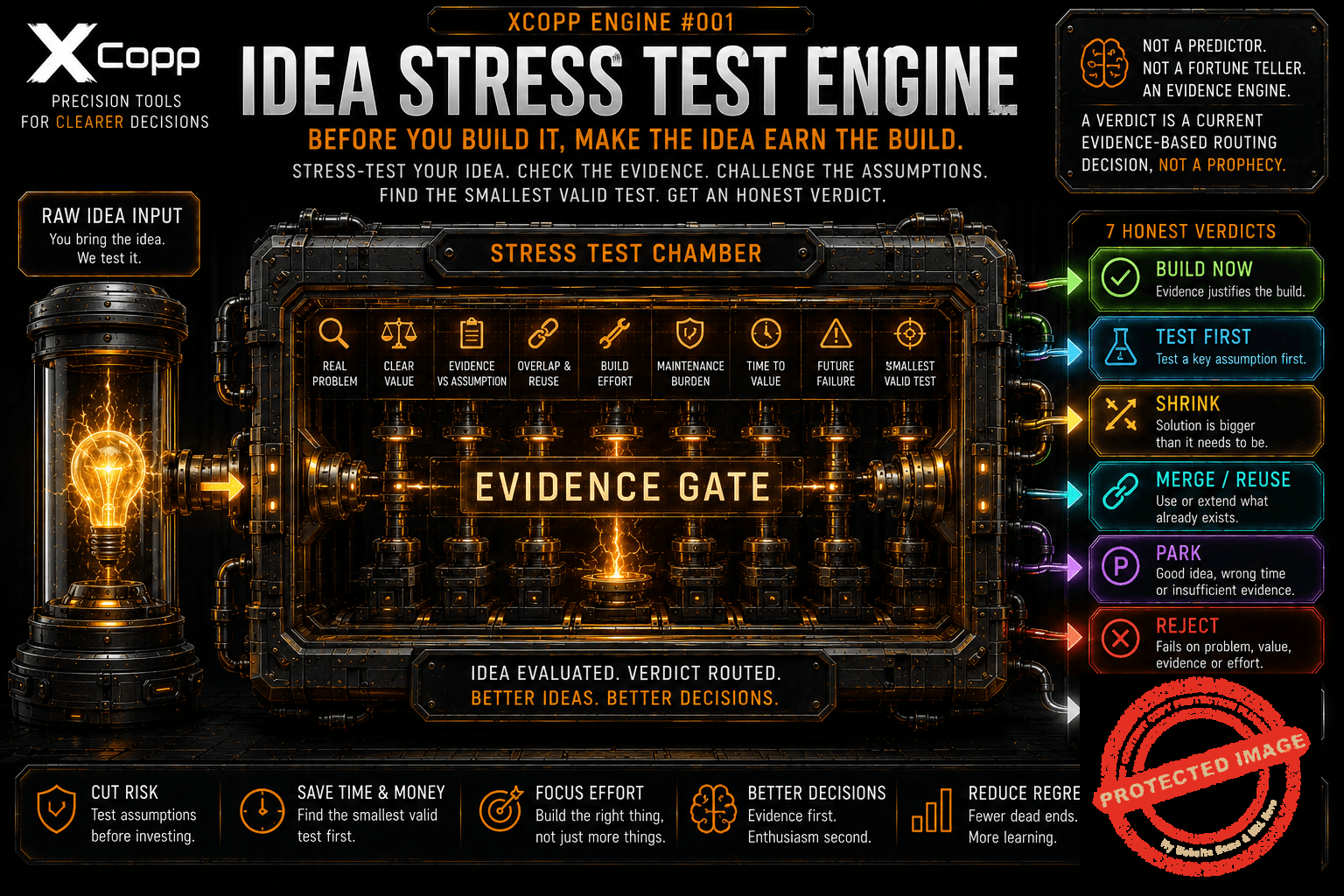
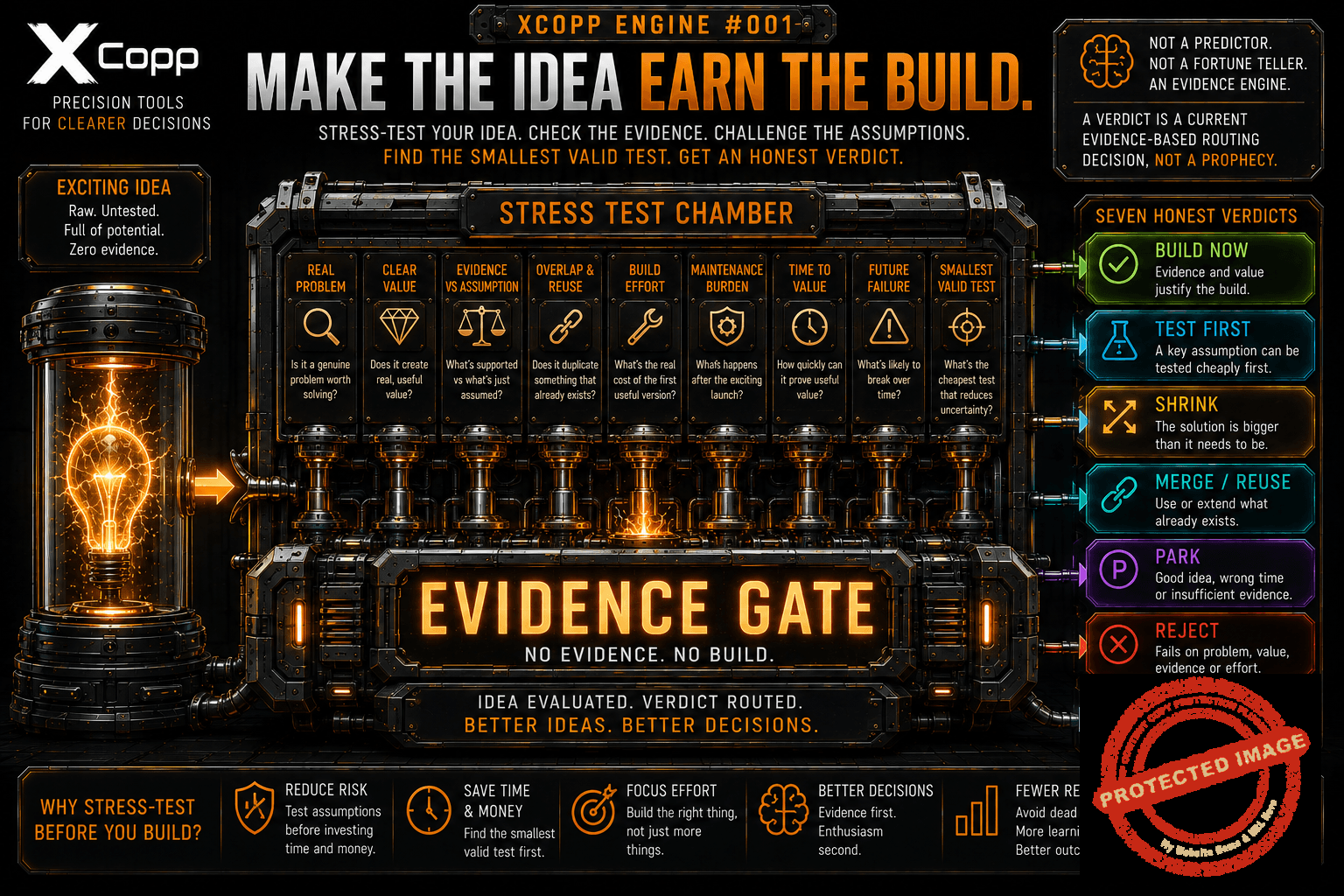

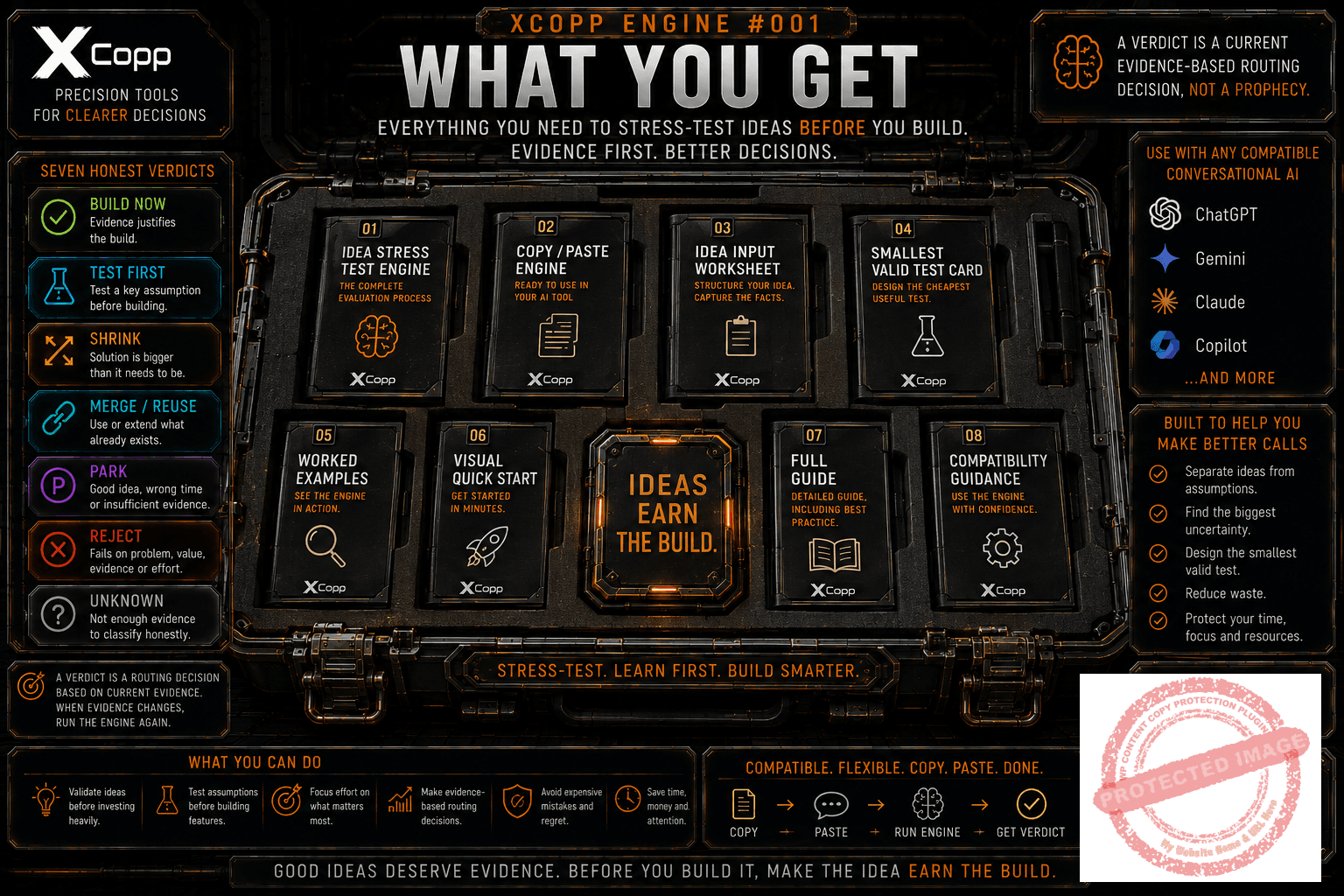
Before you build it, make the idea earn the build.
A new idea can feel productive immediately.
Then you make the folder.
Buy the domain.
Design the system.
Build twelve features.
And three months later discover that the original assumption was never actually tested.
Idea Stress Test Engine inserts an evidence gate before the expensive bit.
Give it an idea and the available evidence. It tests whether that idea deserves to be built, tested, shrunk, merged, parked or rejected before it consumes serious time, money, attention or architecture.
Enthusiasm is not evidence.
An idea does not earn a build merely because it sounds good.
It earns the next level of effort by solving a real problem, creating clear value, surviving useful challenge and producing enough evidence to justify expansion.
The Engine helps separate:
- the idea itself;
- assumptions;
- requirements;
- evidence;
- test results;
- and actual decisions.
Confidence should never outrun the evidence.
What does the Engine test?
Idea Stress Test Engine examines:
- Real problem — is there something genuine to solve?
- Clear value — does the idea create a useful outcome?
- Evidence vs assumptions — what is actually supported?
- Existing overlap — is the problem already owned elsewhere?
- Reusable leverage — can existing assets do some of the job?
- Build effort — what will the first useful version really cost?
- Maintenance burden — what happens after the exciting launch?
- Time to useful result — how quickly can the idea prove value?
- Future failure — what breaks over time?
- Attention and drift — what existing commitment might this displace?
- Smallest valid test — what is the cheapest useful way to reduce uncertainty?
The seven possible verdicts
BUILD NOW
Evidence and value justify the first useful build.
TEST FIRST
The idea looks promising, but a material assumption can be tested cheaply before building.
SHRINK
The problem may be valid, but the proposed solution is larger than it needs to be.
MERGE / REUSE
An existing project, product, system or asset should own most of the solution.
PARK
Potential value exists, but timing, priority or available evidence does not currently justify the effort.
REJECT
The idea currently fails strongly enough on problem, value, maintenance or evidence that further effort is not justified.
UNKNOWN
There is not enough evidence to classify the idea honestly.
UNKNOWN is better than fake certainty.
Not an idea killer.
The point is not pessimism.
A strong idea should survive useful challenge.
A weak assumption should be tested cheaply.
An oversized solution should get smaller.
A duplicate should reuse what already exists.
And sometimes the correct next action is simply:
Don’t build anything yet.
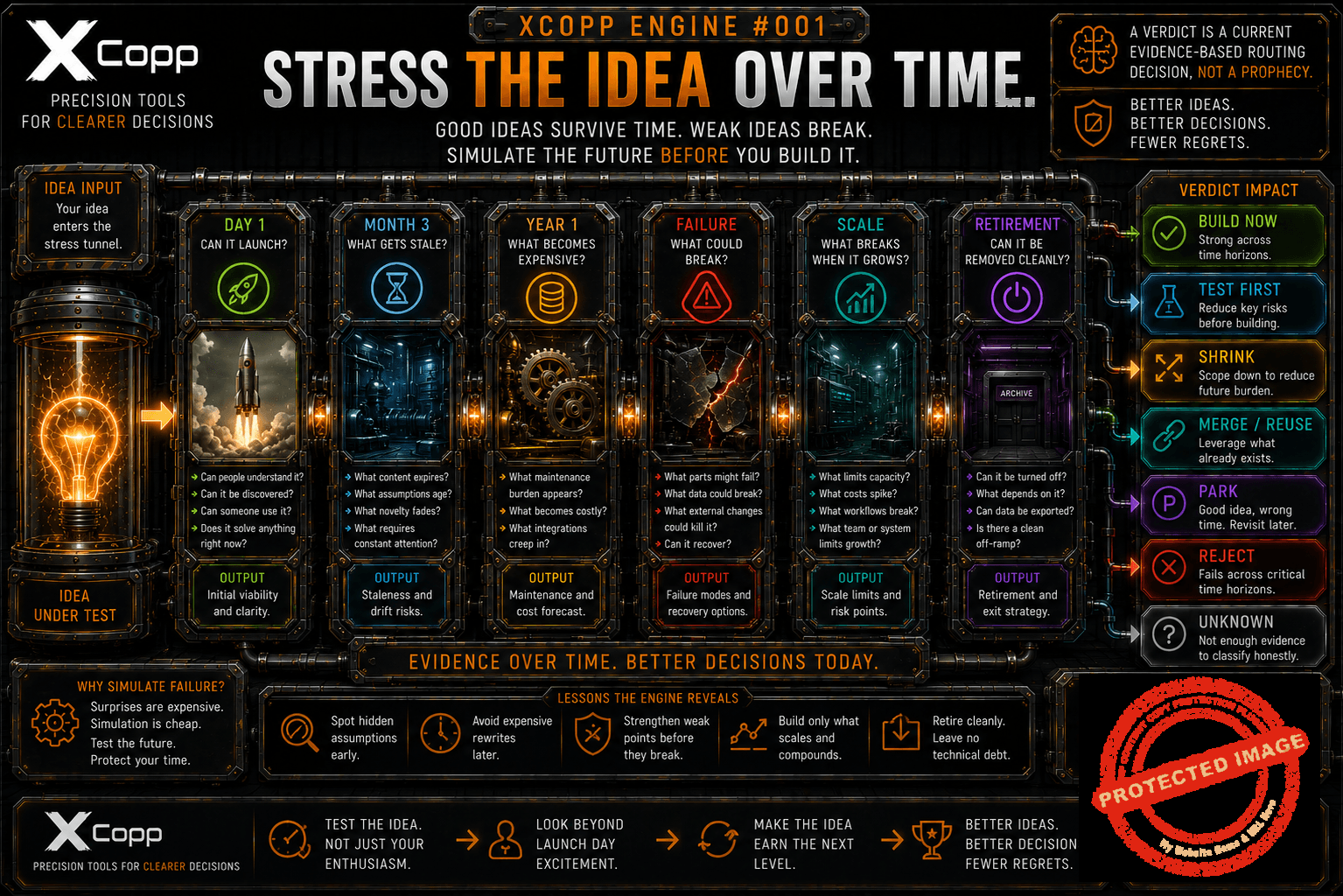
The failure simulation
The Engine also looks beyond launch-day excitement.
DAY 1
Can somebody understand and use the idea?
MONTH 3
What is likely to become stale?
YEAR 1
What maintenance burden appears?
FAILURE
Can the project recover?
SCALE
What breaks when usage grows?
RETIREMENT
Can the idea be archived or removed without leaving broken dependencies?
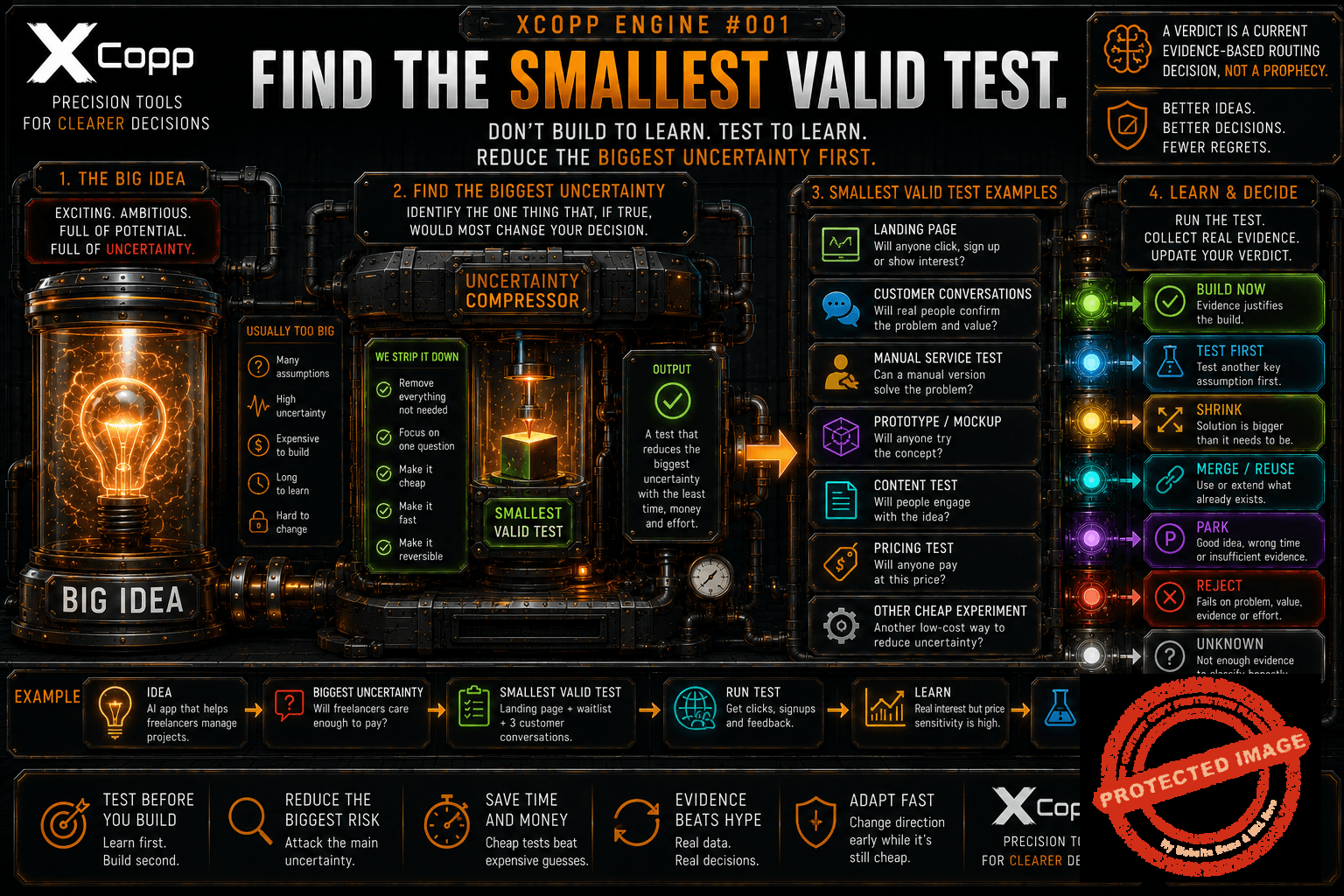
Find the biggest uncertainty first.
If weak evidence is the main problem, building more architecture is usually not the answer.
The Engine identifies the biggest uncertainty and designs the Smallest Valid Test capable of reducing it.
That might be:
- a landing page;
- customer conversations;
- a manual service test;
- a prototype;
- a content experiment;
- a pricing test;
- or another cheap and reversible validation step.
The aim is simple:
Learn before you build more than you need.
Example
Imagine your idea is:
“I want to build an AI app for X.”
The Engine might expose:
ASSUMPTION: people will pay.
EVIDENCE: none yet.
BIGGEST UNCERTAINTY: demand.
SMALLEST TEST: landing page, customer conversations or manual service test.
VERDICT: TEST FIRST.
Instead of spending forty hours building something to answer a question that could have been tested in forty minutes, you get evidence first.
What you receive
Your download includes:
- Idea Stress Test Engine — the complete staged evaluation process;
- Copy/Paste Engine — ready for direct use in a compatible conversational AI;
- Idea Input Worksheet — structure your idea before testing it;
- Smallest Valid Test Card — define the cheapest useful evidence-gathering test;
- Worked Examples — see the Engine applied to sample ideas;
- Visual Quick Start — get started quickly;
- Full Guide — detailed operating guidance;
- Compatibility Guidance — practical notes for using the Engine with conversational AI.
Who is it for?
- builders;
- creators;
- founders;
- side-project addicts;
- AI power users;
- product makers;
- small teams;
- anyone with more ideas than available hours.
Does it predict whether my idea will succeed?
No.
Idea Stress Test Engine does not predict commercial success.
Its verdict is a current evidence-based routing decision based on the information supplied.
When material evidence changes, run the Engine again.
Good ideas deserve evidence.
Bad assumptions deserve cheap tests.
Before you build it, make the idea earn the build.
Reviews
There are no reviews yet.