
When understanding is not enough.
XCopp BlackBoxes are structured operating systems for builders who need to move from knowing what should happen to controlling how the work actually gets done.
Use a BlackBox when the problem is no longer a lack of information — it is continuity, decisions, execution, control, or repeatability.
Systems built for execution, not just explanation.
A BlackBox takes a recurring or complex problem and gives it structure: inputs, decisions, controls, workflow, checkpoints, records, and recovery paths.
Where a Fragment helps with one focused problem and a DataDump helps you understand the wider subject, a BlackBox helps you operate the work repeatedly without rebuilding the method every time.
This is the deepest XCopp product layer because it is designed for ongoing execution rather than one-off guidance.
A BlackBox turns good judgement into repeatable operation.
The aim is not complexity. It is to stop important work depending on memory, improvisation, scattered decisions, and repeated guesswork.
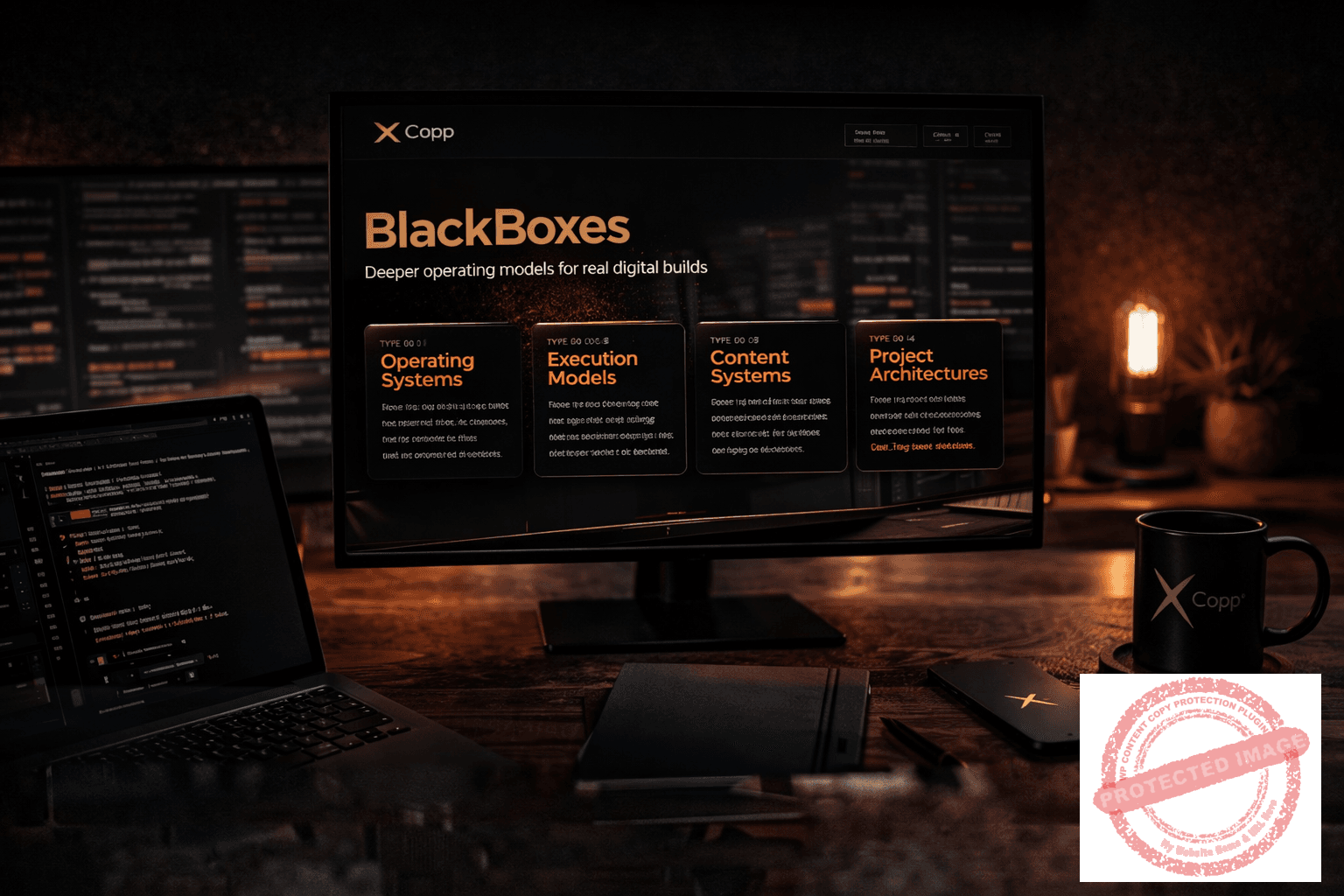
Good work falls apart when the operating method lives only in your head.
Projects drift when decisions disappear, context is lost, steps are skipped, quality checks become inconsistent, and every restart requires reconstructing what happened before.
BlackBoxes make the operating logic explicit. They give important work a repeatable structure so progress does not depend entirely on memory, mood, or improvisation.
Repeatability is not bureaucracy when it protects the build.
The right system removes unnecessary decisions, preserves useful context, exposes failure points, and makes the next action clearer.
Use one when the work needs control.
BlackBoxes are useful when the same important problem keeps appearing and a loose collection of notes is no longer enough.
Context Keeps Getting Lost
Preserve decisions, state, source material, progress, and recovery information across longer projects.
Choices Need Structure
Stop consequential decisions disappearing into chat, memory, or undocumented assumptions.
The Work Keeps Drifting
Give a project defined stages, controls, checkpoints, and clearer next actions instead of random motion.
You Keep Rebuilding the Method
Turn a useful way of working into a reusable operating structure instead of recreating it from scratch.
Choose the system your work needs.
Five operating systems built around different execution problems. Start with the one that removes the blocker in front of you.
AI Project Continuity Toolkit
Keep longer AI-assisted projects coherent across sessions by preserving context, decisions, project state, recovery information, and the next meaningful action.
View BlackBox →Decision BlackBox
Give important decisions a controlled process for evidence, assumptions, reasoning, consequences, records, and later review instead of letting them disappear into memory.
View BlackBox →Idea Stress Test Engine
Put ideas under pressure before investing heavily in them by examining assumptions, weaknesses, evidence, feasibility, consequences, and what could invalidate the concept.
View BlackBox →Personal AI OS Blueprint
Structure a personal AI working environment around context, projects, roles, sources, decisions, continuity, and operating boundaries instead of disconnected chats.
View BlackBox →Website Build BlackBox
Control a website build from scope and architecture through page construction, integrations, QA, recovery, launch, handover, and ongoing maintenance.
View BlackBox →Understand It Before You Operate It
If the problem is still understanding rather than execution, step back into the DataDump layer before adding a full operating system.
Explore DataDumps →Not every problem needs a BlackBox.
This layer is for builders whose problem has moved beyond knowing what to do and into controlling how the work gets done.
System Thinkers
Builders who want to understand and control how decisions, information, workflow, and outputs connect instead of treating each task in isolation.
Operators
People responsible for getting real work over the line who need clearer stages, controls, checkpoints, records, and recovery paths.
Repeat Builders
People who have solved a problem once and now need a reliable way to solve it again without rebuilding the operating method from zero.
BlackBoxes are the execution layer of XCopp.
Fragments solve focused tactical problems. DataDumps help you understand wider subjects and their moving parts. BlackBoxes take the next step by turning that understanding into controlled execution.
You do not move through the layers because deeper is automatically better. You move because the problem requires more structure.
Fragment → DataDump → BlackBox
Solve the focused problem. Understand the wider system. Operate the work when repeatability and control become necessary.
Do not install a system where a smaller answer will do.
BlackBoxes are for problems that genuinely need repeatable execution and control. If you are still learning the subject, start lighter.
Need something tactical instead? Explore Fragments.
Even the deepest systems need the right compass behind them.
XCopp is not interested in system complexity for its own sake. A framework earns its place only when it helps produce clearer decisions, stronger work, and useful outcomes.
For me, the compass remains simple: walk with God, build with GRIT, and let every system serve something honest, useful, and worth the labour it took to build.
Understand the problem. Control the process. Keep building.